

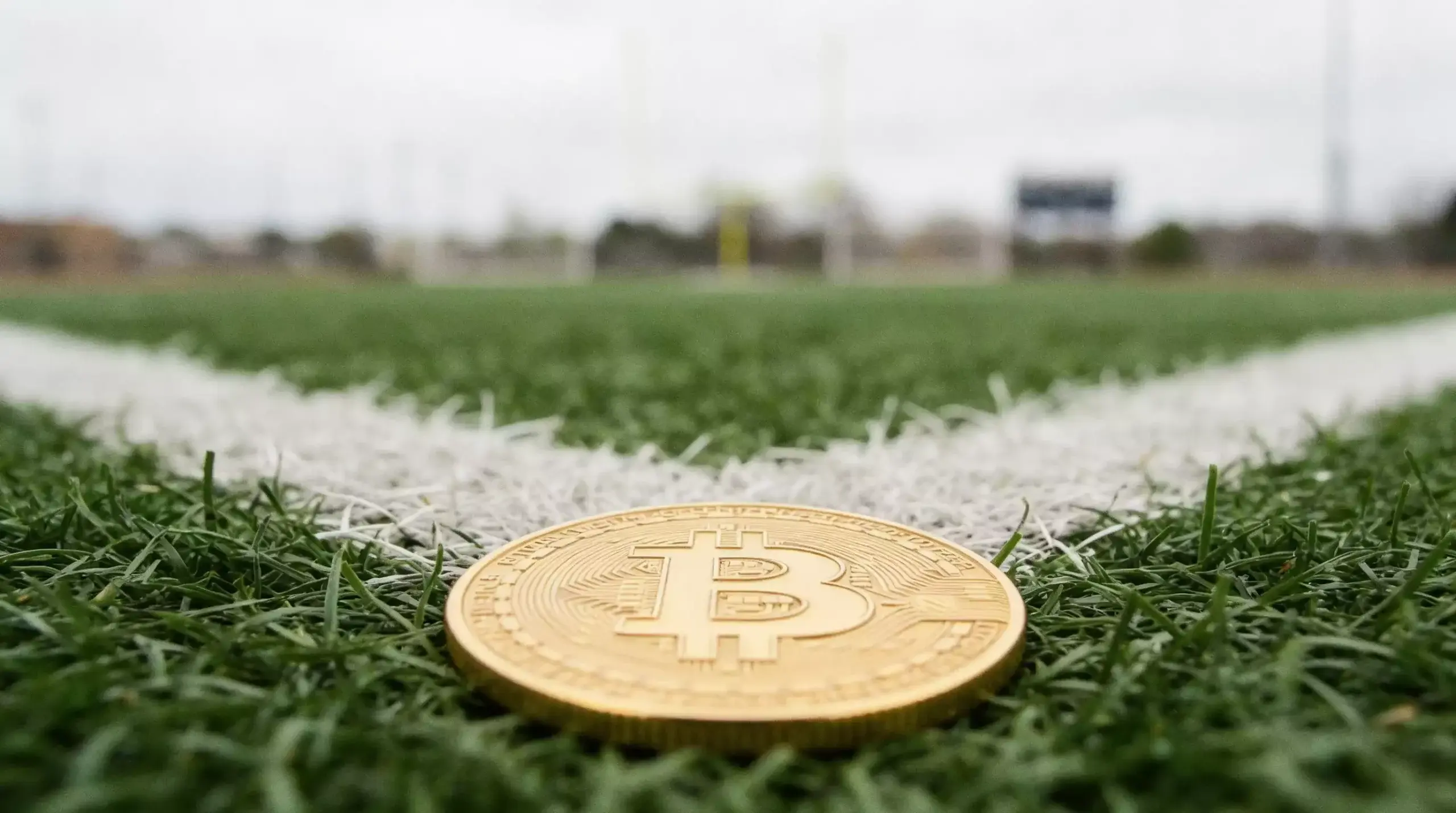
Bitcoin Default Utility in NFL Crypto Wagering
Every September, I reset my NFL betting bankroll. And every September, the first deposit I make is in Bitcoin. Not because it is the cheapest option — it is not. Not because it is the fastest — it definitely is not. But because Bitcoin is the one cryptocurrency that every single crypto sportsbook accepts without exception, and when you are setting up accounts across multiple platforms to compare NFL lines, that universality matters more than a few pennies in network fees.
Bitcoin’s dominance in crypto gambling is not a matter of opinion — it is structural. Roughly half of all Bitcoin transactions are connected to gambling activity. That statistic surprises people who think of BTC primarily as a store of value or a speculative asset, but for the crypto sportsbook ecosystem, Bitcoin is the original payment rail and remains the most liquid. The global crypto gambling sector generated $81.4 billion in revenue in 2024, and Bitcoin facilitated the largest share of that volume. Ethereum, Litecoin, and stablecoins have all carved out meaningful niches, but none has displaced BTC as the default deposit method at the cashier page.
For UK bettors specifically, Bitcoin offers a practical advantage that is easy to overlook: availability. Every major UK crypto exchange — from the FCA-registered platforms to the global exchanges accessible from British IP addresses — supports BTC purchases via bank transfer, debit card, or Apple Pay. Buying Litecoin or a Tron-based stablecoin often requires an extra step: purchasing BTC or ETH first, then swapping. Bitcoin eliminates that friction. You buy it, you send it, you bet.
That said, Bitcoin comes with trade-offs that are specific to NFL betting, and understanding them is the difference between using BTC effectively and losing value to fees, confirmation delays, and exchange-rate slippage. The rest of this piece breaks down those mechanics in the kind of detail that matters when real money — and real NFL action — is on the line.
If Bitcoin network fees become too high during peak hours, switching to Litecoin NFL betting can offer faster and cheaper deposits.
Bitcoin Transaction Mechanics for Bettors
A Bitcoin deposit to a sportsbook is not a bank transfer wearing a different hat. It is a fundamentally different process, and the mechanics shape your experience at every stage — from the moment you click “deposit” to the moment your balance updates.
When you initiate a deposit, the sportsbook generates a unique Bitcoin address for your account. You copy that address into your wallet application, enter the amount, and broadcast the transaction to the Bitcoin network. From here, your transaction enters the mempool — a waiting room of unconfirmed transactions — where miners select which transactions to include in the next block based primarily on the fee attached. A higher fee means faster confirmation. A lower fee means you wait.
Bitcoin’s block time averages roughly ten minutes, but that is an average across the network, not a guarantee for your specific transaction. During periods of high network activity — which tend to coincide with bullish price action, not with NFL kickoff times — the mempool can become congested. I have seen Sunday-morning deposits (UK time, ahead of the 6 PM kickoff slate) confirm in eight minutes during quiet network periods and sit unconfirmed for over an hour during Bitcoin price spikes. If you are depositing to place a pregame bet, timing your transaction to avoid network congestion is a genuine skill.
Most sportsbooks require between one and three confirmations before crediting your account. One confirmation means your transaction appeared in a single mined block — roughly ten minutes at baseline. Three confirmations means three subsequent blocks have been mined on top of the one containing your transaction, adding roughly twenty to thirty minutes. The confirmation threshold is a security measure: the more confirmations, the harder it is for a malicious actor to reverse the transaction through a 51% attack. For deposits under $1,000, one confirmation is standard. Larger deposits sometimes trigger a three-confirmation requirement.
The fee you pay is denominated in satoshis per virtual byte (sat/vB), and it fluctuates with network demand. At the time of writing, a medium-priority Bitcoin transaction costs between 5,000 and 15,000 satoshis — roughly $3 to $10 depending on Bitcoin’s price and network conditions. That is a fixed cost regardless of the amount you send: depositing 0.001 BTC costs the same network fee as depositing 1 BTC. For smaller deposits, this fee represents a meaningful percentage of your bankroll. For larger deposits, it is negligible. I generally batch my deposits — loading up once or twice per month rather than making small deposits before each game — specifically to amortise that fee across more wagers.
One technical detail that trips up newcomers: Bitcoin addresses come in different formats (Legacy, SegWit, Native SegWit, and Taproot), and sending from one format to a sportsbook that specifies another can cause delays or, in rare cases, lost funds. Always match the address format the sportsbook provides. If they give you an address starting with “bc1”, send from a wallet that supports Native SegWit (bech32). If the address starts with “3”, it is a SegWit-compatible address. Mismatches usually resolve eventually, but the delay can cost you a betting window.
On-Chain vs Lightning Network Deposits
The Lightning Network changed my relationship with Bitcoin deposits. Where I used to plan my bankroll loading a day in advance to account for confirmation times, Lightning lets me deposit in seconds — literally seconds — with fees measured in fractions of a penny rather than dollars.
Lightning is a Layer 2 payment network built on top of the Bitcoin blockchain. Instead of broadcasting every transaction to the main chain and waiting for miners to include it in a block, Lightning routes payments through a network of pre-funded channels. The transaction settles almost instantly between the sender and receiver, and only the net result is eventually recorded on the main blockchain. For a bettor, this means your deposit can appear in your sportsbook balance before you finish switching tabs back to the NFL schedule.
The trade-off is adoption. By 2026, mobile betting accounts for an estimated 80% of all crypto gambling activity, and Lightning wallet support on mobile has improved significantly — apps like Muun, Phoenix, and Breez make Lightning transactions nearly as simple as a standard Bitcoin send. But on the sportsbook side, Lightning support is still not universal. The largest crypto sportsbooks have integrated it; many mid-tier platforms have not. Before building your deposit workflow around Lightning, confirm that your chosen sportsbook actually supports it. If the cashier page only shows a standard Bitcoin address (no Lightning invoice, no QR code with an “lnbc” prefix), the platform does not accept Lightning deposits.
For NFL betting specifically, Lightning’s speed advantage is most valuable for live betting and late-breaking situations. If an injury report drops thirty minutes before kickoff and you want to adjust your position, an on-chain Bitcoin deposit will not clear in time. A Lightning deposit will. That speed differential has directly affected my wagering on at least a dozen occasions over the past two seasons — enough to make Lightning support a genuine factor in my platform selection.
One caveat: Lightning deposits typically have lower maximum amounts than on-chain deposits. Channel capacity limits mean most Lightning transactions cap out at a few hundred thousand satoshis — roughly $500-1,000 depending on BTC price. For larger deposits, on-chain remains the only Bitcoin option. The practical solution I use is Lightning for top-ups and time-sensitive deposits, on-chain for larger bankroll loads planned in advance.
Discover the most reliable sportsbooks that accept BTC on the top crypto NFL betting site in the UK.
How Bitcoin Sportsbooks Display NFL Odds
The first time I loaded a Bitcoin sportsbook from a UK IP address, the NFL odds were displayed in American format. Kansas City Chiefs -145, Cincinnati Bengals +125. I had spent years reading decimal and fractional odds at British bookmakers, and my brain refused to process the information quickly. That friction is real, and it costs bettors who do not adjust their workflow.
NFL betting drives 35% of all wagers on crypto sportsbooks, and that concentration comes overwhelmingly from US-based bettors. The result is an American-centric default: most platforms display NFL odds in moneyline format (-110, +200, -350) unless you manually switch. Decimal odds — the standard in UK and European betting — are available on virtually every platform, but you need to find the setting. It is usually buried in account preferences or accessible via a toggle on the odds display itself.
The conversion is straightforward once you internalise it. Negative American odds tell you how much you need to stake to win $100. Positive American odds tell you how much you win on a $100 stake. In decimal terms: -110 converts to 1.91, +150 converts to 2.50, -200 converts to 1.50. Fractional equivalents: -110 is roughly 10/11, +150 is 3/2, -200 is 1/2. If you are comparing lines across a crypto sportsbook and a UK bookmaker simultaneously — which I do every week during the NFL season — working in decimal format on both platforms eliminates the mental overhead.
One quirk of Bitcoin sportsbooks: some display potential payouts in BTC rather than fiat currency. A 0.01 BTC wager at 1.91 decimal odds returns 0.0191 BTC. The nominal precision is appealing — you see exactly how many satoshis you stand to gain. But it also obscures the fiat value of your bet, which is the number that actually matters for bankroll accounting unless you are holding BTC long-term and thinking in purely Bitcoin-native terms. I switched to tracking all my NFL wagers in GBP equivalent years ago, regardless of which cryptocurrency I used to deposit. The crypto is the payment method; the currency of analysis is pounds.
Another display consideration: odds update frequency. At a UKGC-licensed bookmaker, NFL odds typically update every few seconds during live play. Crypto sportsbooks vary more widely. Some mirror the major US sportsbooks’ feeds with near-real-time updates; others lag noticeably, particularly on less liquid markets like second-half props or alternative spreads. If you are line-shopping between platforms — and you should be — the timestamp or “last updated” indicator on the odds display tells you whether you are looking at current prices or stale ones.
Deposit and Withdrawal Limits in BTC
Limits are the unglamorous part of Bitcoin NFL betting that nobody talks about until they run into one. I have had a £2,000 Super Bowl futures payout held up for three days because the sportsbook’s daily BTC withdrawal cap was lower than the payout amount. That experience taught me to read the fine print before placing the bet, not after winning it.
Deposit minimums at Bitcoin sportsbooks typically range from 0.0001 BTC to 0.001 BTC — roughly $10 to $100 depending on the Bitcoin price. These minimums exist partly to cover network fees (a deposit smaller than the fee to process it is economically irrational) and partly to filter out dust transactions that clog the platform’s accounting systems. For NFL bettors making regular weekly deposits, these minimums are rarely an issue. For someone testing a new platform with a small trial deposit, the minimum can feel disproportionately high.
Withdrawal limits are where things get material. Stake.com, the largest crypto sportsbook by volume, processes roughly $10 billion in monthly wagers and has correspondingly high withdrawal ceilings. Smaller operators — particularly newer ones — may set daily withdrawal caps as low as $5,000 or $10,000 equivalent. If your bankroll and your ambitions exceed those limits, you need to verify the platform’s maximum withdrawal before you deposit, not after you win.
Some platforms impose tiered withdrawal limits based on account verification level. At the base tier — email registration only, no identity documents — the daily limit might be $2,000. Upload a government ID and proof of address, and the limit rises to $20,000. Complete enhanced verification, and the cap lifts further or disappears entirely. This tiered structure creates an uncomfortable tension for bettors who came to crypto sportsbooks partly for privacy: the more you want to withdraw, the more personal information you must provide. Understanding where your expected withdrawal amounts sit relative to these tiers before you start betting is basic due diligence that too many bettors skip.
BTC-specific limits also interact with price volatility. A withdrawal cap set at 0.5 BTC is worth different fiat amounts depending on the day. Some sportsbooks set their limits in BTC, others in USD or EUR equivalent. The former is more transparent but creates a moving target in fiat terms; the latter is easier to plan around but means the BTC amount you can withdraw changes daily. Neither approach is objectively better — just different, and worth knowing before you encounter it under time pressure.
Managing BTC Volatility During an NFL Season
The 2022 NFL season taught me more about BTC volatility management than any trading course ever did. I deposited my season bankroll in September at $20,000 per Bitcoin, watched the price drop to $16,000 by November, and suddenly my bankroll — still intact in betting terms — had lost 20% of its fiat value. My NFL bets were winning. My currency was losing. The net effect was a wash, and that is a deeply frustrating outcome for a bettor who did the analysis work correctly.
This is the central tension of Bitcoin NFL betting: you are making a sports wager and a currency bet simultaneously, whether you intend to or not. A winning parlay that pays 4:1 in BTC is only a winning parlay in real terms if Bitcoin’s price has not declined by more than your profit margin in the time between your deposit and your withdrawal.
The regulatory expert Tom Elliot captured the nuance well when he noted that crypto can actually support a more robust control environment than fiat payments in certain respects — but the volatility dimension is genuinely new territory for bettors. Traditional bankroll management assumes a stable unit of account. Bitcoin shatters that assumption.
I have settled on a three-part approach after years of trial and error. First, I minimise my BTC exposure window. I buy Bitcoin on a UK exchange, deposit it at the sportsbook, and place my bets within the same day. I do not hold BTC in my sportsbook account between betting weeks unless I have active positions. Second, I withdraw winnings promptly — usually within 24 hours of settlement — and convert back to GBP or to a stablecoin if I plan to re-deposit the following week. Third, I size my bankroll in fiat terms and convert to BTC at deposit time, rather than thinking of my bankroll as “0.1 BTC” and letting the fiat value float.
Some bettors take the opposite approach: they hold their entire sports betting bankroll in Bitcoin long-term, treat price appreciation as a bonus and price declines as a cost of doing business, and size their bets relative to their BTC balance rather than its fiat equivalent. This approach works if your conviction on Bitcoin’s long-term trajectory is strong enough to absorb short-term drawdowns. It does not work if a 30% BTC decline during the NFL season would cause you to reduce your bet sizing or, worse, chase losses to recover fiat value.
For bettors who want the payment convenience of crypto without the volatility risk, stablecoin sports betting eliminates the currency exposure entirely. A USDT deposit holds its dollar value whether Bitcoin rallies or crashes. The trade-off is that you forfeit any potential BTC upside — but for someone whose edge comes from NFL analysis, not cryptocurrency speculation, that trade-off is usually correct.
The NFL season runs from September through early February — five months of exposure. In crypto terms, five months is a geological era. Bitcoin’s price can move 40% in either direction over that span. Managing that volatility is not an afterthought to your NFL betting strategy; it is part of the strategy itself.
